
OSHA · Free course
Excavation & Trenching Safety
Why trenches collapse and how to work in and around excavations safely: the cave-in hazard and the competent person, locating underground utilities and clearing…
What you’ll learn
By the end of this course.
Explain why cave-ins are the deadliest excavation hazard and the role of the competent person in identifying hazards and authorizing corrective action — 1926.650(b), 1926.651(k)
Describe the pre-dig steps: determining the location of underground installations/utilities and removing or supporting surface encumbrances — 1926.651(a),(b)
State when a protective system is required (excavations 5 feet or more deep, unless in stable rock) and when a registered professional engineer must design it (deeper than 20 feet) — 1926.652(a)(1),(b)(4)
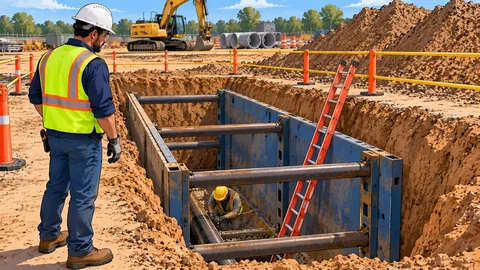
Identify the four soil classifications and the three protective-system methods: sloping/benching, shoring, and shielding (trench boxes) — 1926.652(b),(c) and Subpart P App A
Describe safe means of egress: a ladder, stairway, or ramp within 25 feet of lateral travel in trenches 4 feet or more deep, and keeping spoil piles at least 2 feet from the edge — 1926.651(c)(2),(j)(2)
Recognize hazardous-atmosphere testing and water-accumulation controls, and the requirement for daily and as-needed competent-person inspections — 1926.651(g),(h),(k)
References & standards
Grounded in the source material.
- 29 CFR 1926 Subpart P — Excavations
- 1926.650 — Scope, application, and definitions
- 1926.651 — Specific excavation requirements
- 1926.652 — Requirements for protective systems
This is awareness training. It supports your program; it is not a substitute for site-specific procedures or hands-on competency where a standard requires it.
More OSHA courses
Keep building the program.
Start this course free.
EHSTEC LMS Lite is free for employers to assign — 100 safety courses, no cost. Paid plans add certificates, reporting and proof of completion.